
Home / Share on Social Media How a Virtual Assistant can help Small Businesses in...
Read More
Offshore Staffing for UK Businesses: What You Need to Know
The UK job market is facing one of its most challenging periods in decades. Skills shortages, rising recruitment costs, and widening talent gaps are placing increasing pressure on businesses across every sector. From IT specialists to customer service professionals, local hiring has become both competitive and expensive.
To overcome these challenges, many UK businesses are turning to offshore staffing—a strategic approach that enables companies to hire skilled professionals from overseas while maintaining full control over their operations.
This guide provides clarity, actionable insights, real-world considerations, and trustworthy guidance on how offshore staffing works, its benefits, challenges, and how to achieve success.
What Exactly is Offshore Staffing?
Offshore staffing refers to hiring employees based in other countries (usually lower-cost markets) to perform roles that support your business. Unlike traditional outsourcing, where tasks or projects are contracted to a third-party company, offshore staffing often involves directly employing or retaining remote staff (via an employer of record or a staffing provider) who become part of your distributed team.
Offshore staffing is now a $85 billion global industry, with over 60% of Fortune 500 companies offshoring at least one function. UK adoption is rising, particularly in tech and customer service
Key Differences from Outsourcing:
- Control: With offshore staff, you often manage day-to-day work directly (as with in-house teams), whereas outsourcing hands off control to vendor teams.
- Long-term alignment: Offshore hires tend to be more integrated into your company culture and long-term goals, rather than purely transactional.
- Cost structure: Offshore staffing spreads cost via salaries and employment overheads; outsourcing often uses fixed or per-project pricing.
Industries Leverage Offshore Talent:
Several sectors in the UK are already making heavy use of offshore staffing:
- IT & Software Development: Offshore developers, QA, support
- Finance & Accounting: Back-office accounting, bookkeeping, financial analysis
- Customer Support & Call Centres: Outsourced or staffed via remote agents
- Creative Services: Design, content writing, digital marketing.
Why UK Businesses Are Turning to Offshore Staffing?
UK businesses are turning to offshore staffing to overcome rising hiring costs, talent shortages, and increasing competition. With limited specialist availability and higher local salaries, companies need faster, more scalable hiring solutions. Offshore staffing provides access to global talent at lower costs, speeds up recruitment, and allows rapid team expansion. What once was a cost-saving tactic has now become a strategic advantage that supports long-term growth, innovation, and operational resilience.
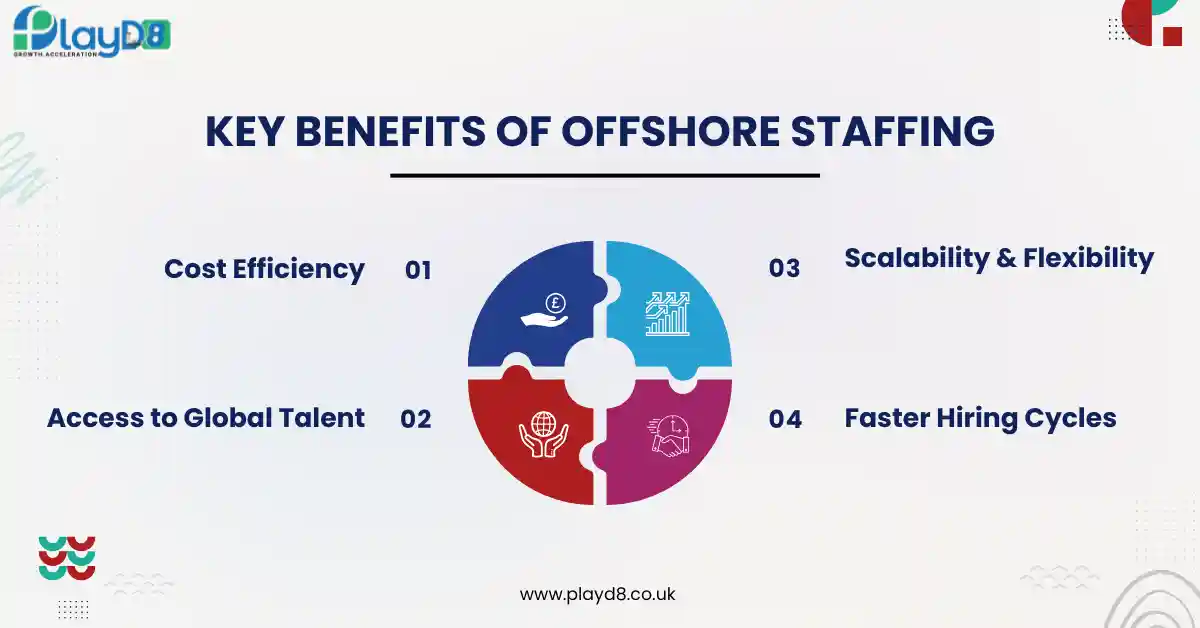
Key Benefits of Offshore Staffing:
1. Cost Efficiency
Hiring offshore allows UK businesses to significantly reduce:
- Salary expenses
- Office space and infrastructure costs
- HR, recruitment, and training overheads
Countries such as Bangladesh, India, the Philippines, and those in Eastern Europe offer highly skilled talent at competitive rates.
2. Access to Global Talent
The UK has a notable shortage of:
- Software developers
- Cybersecurity experts
- Healthcare professionals
- Finance & compliance specialists
Offshore staffing bridges this gap by giving businesses access to a broader global talent pool.
3. Scalability & Flexibility
Do you need to scale your team quickly for a new project? Offshore staffing allows:
- Easy team expansion
- Quick adjustments during peak workload
- Temporary or long-term staffing options
4. Faster Hiring Cycles
Offshore providers often maintain large, pre-screened talent pools. Playd8, for example, enables UK companies to onboard fully vetted staff within 3–10 days, reducing the time it takes to complete traditional hiring cycles by months.
Challenges and Risks to Consider
1. Communication & Cultural Differences
Time zones, accents, and cultural differences in work practices may require adjustment. However, proper onboarding and communication tools reduce friction.
2. Data Security & UK Compliance
UK businesses must ensure offshore teams follow:
- GDPR
- Company security protocols
- Non-disclosure and data protection agreements
3. Quality Control
Some companies struggle to maintain consistent output from remote teams. The solution: clear KPIs, frequent check-ins, and reliable project management tools.
4. Team Engagement
Offshore teams may feel isolated if not properly integrated. Companies must invest in culture-building and regular communication.
Best Practices for Successful Offshore Staffing
1. Define Clear Roles and Responsibilities
Create detailed job descriptions, workflow charts, and expectations to avoid confusion.
2. Invest in Proper Onboarding
Provide:
- Training videos
- Standard operating procedures (SOPs)
- Access to tools and communication channels
3. Use Collaboration Tools
Top tools for seamless communication include:
- Slack / Microsoft Teams
- Trello / Asana
- Zoom / Google Meet
- Notion / ClickUp
4. Establish KPIs & Regular Performance Reviews
Track success using measurable metrics such as:
- Deadlines met
- Work accuracy
- Productivity metrics
- Customer satisfaction ratings
5. Build a Strong Cross-Border Culture
Celebrate wins, encourage open communication, and treat offshore employees as part of the main team.
How to Choose the Right Offshore Staffing Partner
Choosing the right partner can make or break your offshoring success. Providers like Playd8 Offshore Staffing stand out by offering transparent pricing, UK-focused compliance knowledge, and specialised recruitment for SMEs.
What to Look For
- Industry experience (3–10+ years)
- Specialisation in your sector
- Knowledge of UK compliance
- Transparent pricing
- Strong security infrastructure
- Positive testimonials and case studies
Questions to Ask
- How do you source and vet candidates?
- What tools do you use for project management and tracking?
- What are your data protection policies?
- Can we interview candidates before hiring?
- What happens if a candidate doesn’t perform well?
Red Flags
- No clear contracts or GDPR compliance
- Extremely low pricing (often means poor quality)
- Limited communication channels
- Hidden fees
- Lack of case studies or reviews
Examples of Successful UK Use Cases
- A UK fintech company is expanding its development team by utilizing offshore software engineers.
- A London-based e-commerce brand using offshore customer support to run 24/7 live chat.
- A UK-based marketing agency is hiring offshore designers to reduce costs by 60%. Hiring with UK UK-based company, Playd8 businesses can save up to 80%.
Future of Offshore Staffing in the UK
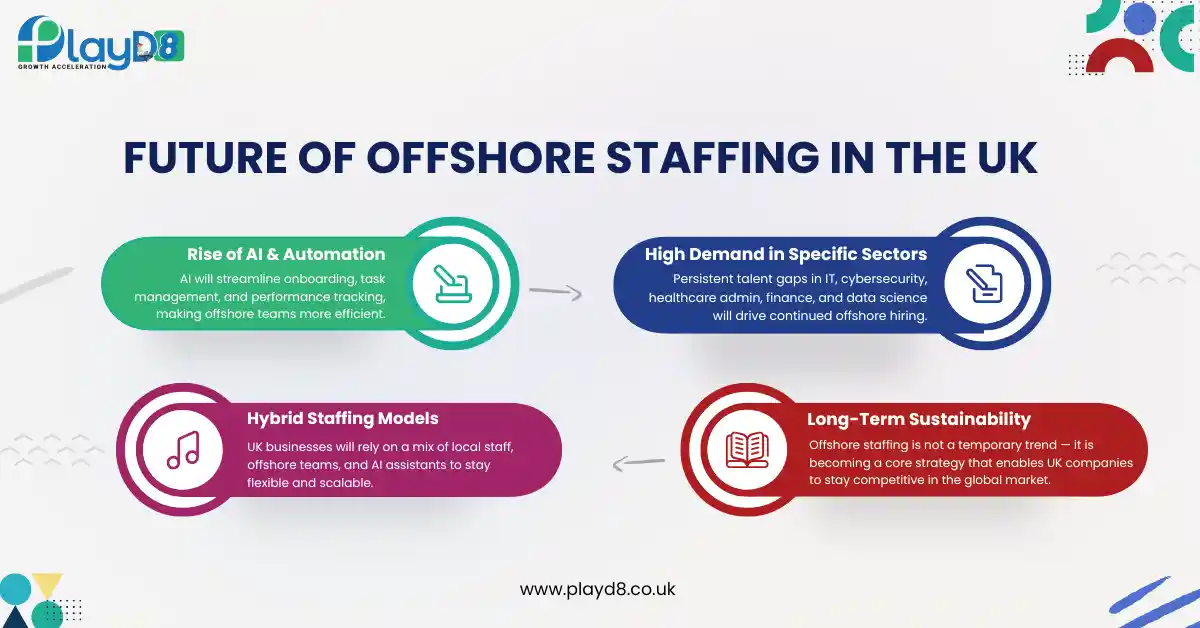
1. Rise of AI & Automation
AI-powered tools will streamline onboarding, task management, and performance monitoring, making offshore staffing more efficient.
2. Hybrid Staffing Models
UK businesses will combine:
- Local UK team members
- Offshore teams
- Automated AI assistants
3. High Demand in Specific Sectors
Future talent shortages are expected in:
- IT & cybersecurity
- Healthcare admin
- Finance & compliance
- Data science
4. Long-Term Sustainability
Offshore staffing is not a temporary trend — it is becoming a core strategy that enables UK companies to stay competitive in the global market.
Conclusion
Offshore staffing is transforming how UK businesses hire, scale, and operate. With the right partner, UK companies can reduce hiring costs, expedite recruitment, and tap into world-class global talent.
PlayD8 helps businesses do exactly that — offering reliable offshore professionals, transparent processes, and end-to-end support to ensure seamless integration with your UK operations.
For businesses ready to evolve, offshore staffing offers a sustainable competitive advantage for years to come.
Frequently Asked Questions
How much can UK businesses save with offshore staffing?
Most UK companies save 40–70% on hiring and operational costs.
Which UK industries benefit most from offshore staffing?
IT, finance, creative services, customer support, and healthcare administration are the biggest adopters.
How quickly can I hire an offshore employee?
With a reliable agency, you can hire a fully vetted candidate in 3–10 days.
Related Articles
Here are some articles you might find interesting.
BPO vs In-House Teams: Which Model Saves You More in 2026?
Home / Share on Social Media BPO vs In-House Teams: Which Model Saves You More...
Read MoreBPO for Small Business in the UK: Save up to 70% on Cost
Home / Share on Social Media BPO for Small Business in the UK: Save up...
Read More10 Mistakes to Avoid When Hiring a BPO Provider in UK
Home / Share on Social Media 10 Mistakes to Avoid When Hiring a BPO Provider...
Read More