
SEO vs GEO for London SMEs: Discover strategies to rank on Google and get cited...
Read MoreHome / Business Process Outsourcing (BPO) / BPO vs In-House Teams: Which Model Saves You More in 2026?

BPO vs In-House Teams: Which Model Saves You More in 2026?
Rising operational costs are pushing businesses to rethink how they manage their workforce. The question most UK companies now face is simple: Is it still cost-effective to keep everything in-house, or does outsourcing (BPO) deliver better long-term value?
The answer isn’t just about cutting expenses — it’s about understanding the real cost structure behind each model. While in-house teams offer more control, they come with hidden costs like recruitment, training, benefits, and infrastructure. BPO, on the other hand, promises lower costs through global talent access, scalability, and reduced overhead — but it also requires trust, communication, and quality assurance.
The Real Cost Comparison: BPO vs In-House For UK Businesses
Direct and Indirect Costs of In-House Teams:
1. Recruitment, Salaries, Benefits, and Insurance
- Recruitment fees or HR time cost for each hire.
- Salaries and bonuses — rising steadily across UK industries.
- Pension, insurance, and holiday pay — legally required costs.
- Employee taxes and national insurance contributions.
2. Infrastructure Costs
- Office rent, utilities, and internet.
- Equipment: laptops, furniture, and peripherals.
- Software licences: Microsoft 365, Adobe, CRM, or ERP tools.
- Maintenance: IT support, cleaning, energy, and depreciation.
3. Training, Turnover, and Compliance
- Training programs for onboarding and skill updates.
- Turnover costs when employees leave (lost productivity + rehiring).
- Compliance & HR management: GDPR, data security, legal audits.
In short, even a £2,500/month salary often becomes £3,200–£3,800/month in real cost once overheads are included.
How BPO Reduces Operational Costs:
Outsourcing eliminates several cost layers and introduces flexibility.
1. Labour Arbitrage (Global Skilled Talent)
- BPOs in regions like the Philippines, India, and Eastern Europe offer 60–80% cost savings on equivalent talent.
- According to Exploding Topics, companies save up to 70% in labour costs by outsourcing abroad.
- Global outsourcing now includes English-fluent, college-educated professionals — not just call centres.
2. Shared Infrastructure and Technology
- BPO vendors manage software, hardware, and data systems across multiple clients.
- SMEs benefit from enterprise-grade tools (CRM, AI analytics, automation) at a fraction of the cost.
- Example: A UK SME might pay £100/month for CRM seats — a BPO includes it in the service price.
3. No Recruitment or Training Overheads
- Vendor recruits and trains their own team.
- Reduced attrition risk: if a staff member leaves, the BPO replaces them.
Flexible billing models: hourly, per-project, or hybrid plans in 2026 make budgeting easier.
Strategic Growth Enablement
- Freeing Leadership Time
By outsourcing routine functions, founders and executives can:
- Focus on innovation and product development
- Explore strategic partnerships
- Allocate more time to marketing, sales, and growth initiatives
- Case Example: Real-World Impact
- A local UK retailer outsourced its back-office data management.
- Leadership focused on creative strategy and expansion.
Result: Business scaled 2x faster within a year.
BPO vs In-House: Operational and Strategic Cost Breakdown
|
Category
|
In-House Teams
|
BPO (Outsourcing Partners)
|
|---|---|---|
|
Cost Control
|
Fixed monthly costs (salary, rent, tools).
|
|
|
Scalability
|
Limited by local hiring and office capacity.
|
|
|
Recruitment & Training
|
Employer handles all.
|
Vendor recruits and trains on your behalf.
|
|
Technology & Tools
|
Need to purchase licences and maintain software.
|
BPO provides shared tech infrastructure and automation.
|
|
Compliance
|
Managed internally (more control).
|
Managed by vendor, must verify certifications (GDPR, ISO).
|
|
Flexibility
|
Rigid — hard to downsize quickly.
|
Highly flexible — project, hourly, or hybrid models.
|
|
Speed to Hire / Execute
|
Weeks to months.
|
Often within days or weeks.
|
|
Long-Term Control
|
High control, deeper culture fit.
|
Moderate control — requires SLAs and dashboards.
|
Summary Insight:
In-house = Control and Culture
BPO = Flexibility and Efficiency
Which Tasks Should You Outsource vs Keep In-House?
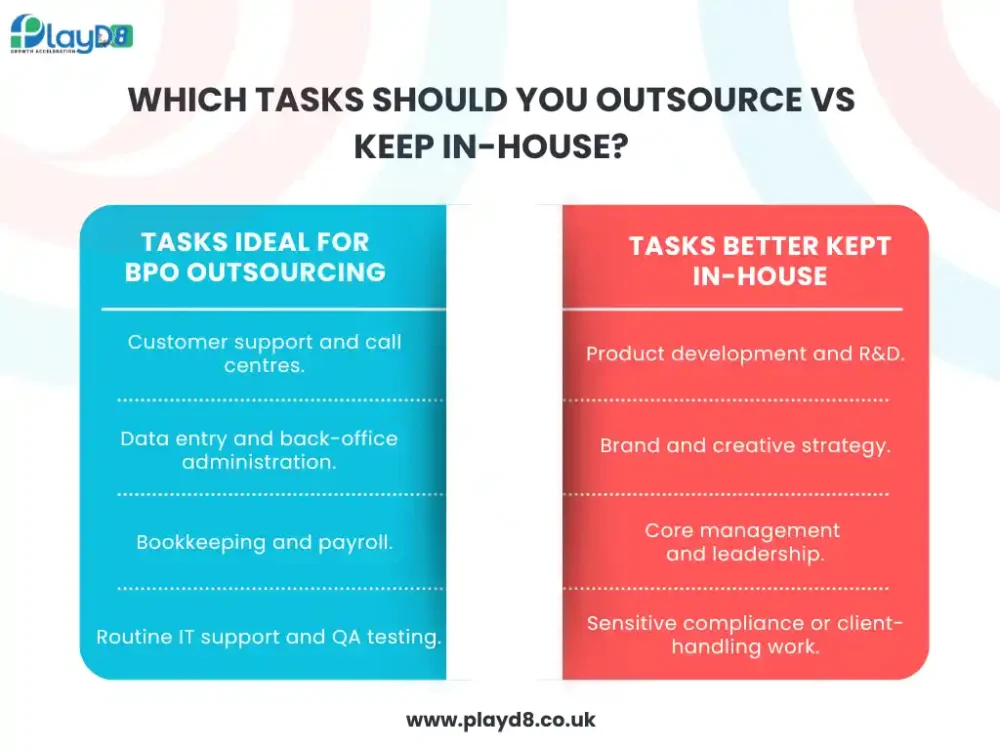
Tasks Ideal for BPO Outsourcing
- Customer support and call centres.
- Data entry and back-office administration.
- Bookkeeping and payroll.
- Routine IT support and QA testing.
Tasks Better Kept In-House
- Product development and R&D.
- Brand and creative strategy.
- Core management and leadership.
- Sensitive compliance or client-handling work.
Simple rule:
If the task is repetitive and measurable, outsource it.
If it’s strategic and culture-driven, keep it in-house.
Pros and Cons: BPO vs In-House Teams
|
Aspect
|
In-House Team
|
BPO / Outsourcing
|
|---|---|---|
|
Pros
|
- Strong cultural alignment.- Greater control and accountability.- Easier real-time collaboration.- Long-term knowledge retention
|
|
|
Cons
|
- High fixed costs.- Slower scaling.- HR and compliance overhead.- Higher turnover cost.
|
Ensuring Quality and Communication with Your BPO Partner
To ensure smooth collaboration with BPO partners:
1. Maintain Transparency
- Define Service Level Agreements (SLAs) tied to KPIs (accuracy rate, resolution time, etc.)
- Use real-time dashboards for performance visibility
2. Strengthen Accountability
- Schedule regular performance reviews and audits
- Use unified project management platforms (e.g., ClickUp, Asana, Hubstaff)
3. Embrace Technology
- 2026 trend: Integrated BPO dashboards provide live performance metrics, employee uptime, and client feedback loops
HFS Research (2025) notes that the industry is shifting focus from cost savings to performance and outcomes
Conclusion
To put it simply:
BPO isn’t just cheaper — it’s smarter when applied strategically.
The smartest businesses in 2026 won’t be asking “BPO or In-House?”
They’ll be asking:
“Which mix gives us the best balance of cost, quality, and agility?”
Outsourcing isn’t about cutting corners—it’s about building a lean, scalable, future-proof organisation ready to thrive in an AI-driven economy.
Frequently Asked Questions
Is BPO still cheaper than in-house hiring in 2026?
Yes — most UK firms save 50–70% by outsourcing, depending on the complexity and location of their BPO partner.
What are the biggest hidden costs of in-house teams?
Recruitment, training, benefits, and office infrastructure — all add 25–40% above base salary.
What are the main risks of outsourcing to BPOs?
Data security, cultural misalignment, and poor SLAs. These issues can be avoided by using verified vendors and implementing proper monitoring.
Can small businesses benefit from outsourcing?
Absolutely. SMEs gain access to professional services (like finance, IT, support) at a fraction of UK-based hiring costs.
Related Articles
Here are some articles you might find interesting.

SEO vs GEO for London SMEs: The 2026 Visibility Strategy
SEO vs GEO for London SMEs: Discover strategies to rank on Google and get cited...
Read More
Local SEO for Small Businesses in London: How to Rank Your Business Faster in 2026
Rank your small business in London faster with proven Local SEO strategies for Google Maps...
Read More
Website Development Services for Small Businesses in London: A Complete Guide
Looking for website development services for small businesses in London? Explore costs, features, SEO integration,...
Read More