SEO vs GEO for London SMEs: Discover strategies to rank on Google and get cited...
Read More
SEO vs GEO for London SMEs: The 2026 Visibility Strategy
In 2026, being visible online for London SMEs isn’t just about ranking on Google. Traditional SEO still drives traffic, but Generative Engine Optimisation (GEO) is becoming equally critical.
SEO ensures your website appears in search results, while GEO ensures your business is cited and referenced inside AI-generated answers — on platforms like ChatGPT, Google AI, and Perplexity.
For SMEs, visibility now has two dimensions:
- Driving website visits through SEO
- Building authority and recognition through GEO
Integrating both strategies allows businesses to reach users who search, ask, or interact with AI assistants — capturing attention even before a click occurs.
Traditional SEO in 2026: What London SMEs Need
Traditional SEO has evolved from a focus on individual keyword rankings to a broader focus on intent-based visibility — matching what users genuinely want to know, not just what they type.
Google itself emphasises people-first content in its official guidance on creating helpful, reliable, people-first content.
This means understanding user intent and structuring content to satisfy that intent. While keywords still matter, modern SEO prioritises context and relevance over keyword density alone.
In 2026, SEO still rests on five pillars:
- Technical SEO — crawlability, site speed, structured markup, and indexing.
- On-page SEO — content that matches search intent and includes relevant keywords, headers, and meta tags.
- Off-page SEO — backlinks and brand mentions from reputable sources.
- Content quality — depth, relevance, and originality.
- User experience (UX) — mobile responsiveness and ease of navigation.
These remain essential for driving traffic from search engines like Google and Bing.
Google Search, Maps, and the Local Pack
For London SMEs, local SEO — optimising for Google Business Profile, Maps, and the Local Pack — is critical. Most urban consumers use “near me” search daily, and local search behaviour often converts to visits or sales.
Google’s Local Pack (the map and top business listings) remains a major driver of traffic and leads. A fully optimised listing, following Google Business Profile best practices, significantly improves visibility and conversions.
The Role of E-E-A-T in SEO Performance
Google’s quality guidelines emphasise E-E-A-T — Experience, Expertise, Authoritativeness, and Trustworthiness. These are used by human quality raters and indirectly shape algorithmic adjustments. Pages with strong E-E-A-T tend to rank better and are seen as more credible.
What Is GEO? (Generative Engine Optimisation)
GEO is the practice of optimising content for AI-generated answers. Unlike SEO, which focuses on ranking for keywords, GEO ensures content is quoted, cited, or summarised by AI engines like ChatGPT, Perplexity, Claude, or Google AI Overviews.
Why GEO Matters:
- AI discovery is growing, with up to 60% zero-click searches
- Enhances brand visibility even without traditional rankings
- Aligns with voice search and conversational queries
Key Differences Between SEO and GEO
|
Factor
|
SEO
|
GEO
|
|---|---|---|
|
Primary Platform
|
Search engines (Google, Bing)
|
|
|
Goal
|
Rank positions
|
|
|
Signals
|
Keywords, backlinks
|
Context, authority, structure
|
|
Traffic
|
Website visits
|
Brand visibility across AI answers
|
|
Measurement
|
Rankings, traffic
|
AI citations, mentions
|
SEO Strategies for London SMEs
Here’s a practical roadmap for London small businesses.
Local SEO Dominance
- Optimise Google Business Profile with updated details and reviews
- Increase Map Pack visibility for high-intent leads
- Create service-specific landing pages targeting London neighbourhoods
Website Authority and Conversion
- Publish expert-led content
- Build backlinks from authoritative local and industry sites
- Ensure fast-loading, mobile-friendly, and accessible pages
GEO Strategies for London SMEs
Appear in AI Summaries & Recommendations
- Structure content clearly for AI extraction (headings, bullet lists, concise answers)
- Include expert insights and statistics to enhance trustworthiness
- Answer common SME-related queries directly
Entity Trust & Authority
- Mention your business name, services, and London location consistently
- Include quotes, citations, and case studies to signal expertise
- Optimise FAQs for voice search and natural language queries
Optimising Content for Both SEO and GEO
Content Structure Tips:
- Topic clusters: Group related questions & answers
- Human-first, expert-led content: Write for readers, structure for machines
- Schema markup: FAQ, Article, Product, LocalBusiness
- Conversational content: Use FAQs, Q&A sections, and clear summaries
Formatting for AI Extraction:
- Short paragraphs and bullet points
- Clear headings (H2/H3) with keywords
- Structured answers with definitions and examples
Use-Case Examples for London SMEs
|
SME Type
|
SEO Focus
|
GEO Focus
|
|---|---|---|
|
Local Services
|
Google Maps, Local Pack, service pages
|
|
|
E-commerce
|
Product page optimisation
|
|
|
B2B Companies
|
Organic discovery via blog and SEO
|
Authority positioning in AI research queries
|
|
Education/Training
|
SEO for course pages
|
Expert answers for curriculum questions
|
Measuring SEO and GEO Performance
SEO KPIs:
- Rankings, organic traffic, bounce rate, conversions
GEO KPIs:
- AI mentions, citations, visibility across generative engines
- Brand awareness from zero-click searches
Tools: Google Search Console, Google Analytics, SEMrush, Ahrefs
SEO and GEO Implementation Roadmap for London SMEs (2026)
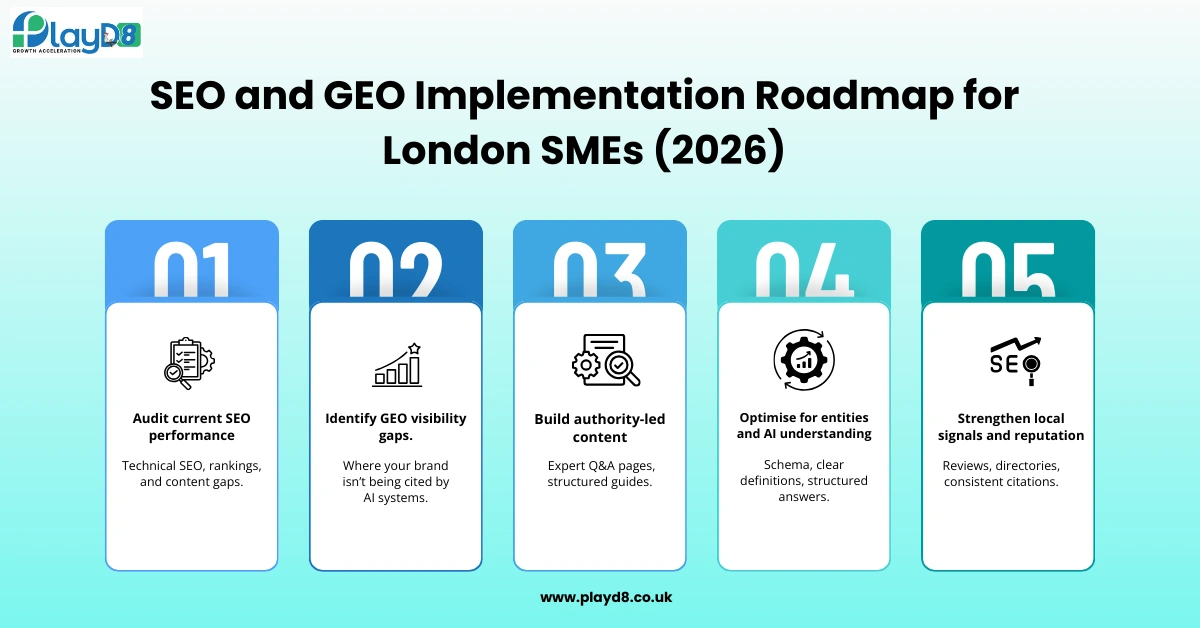
- Audit current SEO performance — technical SEO, rankings, and content gaps.
- Identify GEO visibility gaps — where your brand isn’t being cited by AI systems.
- Build authority-led content — expert Q&A pages, structured guides.
- Optimise for entities and AI understanding — schema, clear definitions, structured answers.
- Strengthen local signals and reputation — reviews, directories, consistent citations.
Conclusion
In 2026, London SMEs need more than rankings — they need dual visibility. SEO remains essential for driving traffic through Google Search, Maps, and local results, generating high-intent leads and conversions. But GEO ensures your business is cited and recommended inside AI-generated answers, shaping decisions before users even click.
As AI-driven discovery grows, authority, structure, and trust become as important as keywords and backlinks. SMEs that combine strong technical and local SEO with expert-led, structured content will dominate both search engines and generative platforms.
SMEs that combine strong SEO with expert-led content and digital marketing services will dominate both search engines and generative platforms.
SEO drives traffic. GEO builds authority. Together, they secure long-term visibility.
Frequently Asked Questions
Is traditional SEO still relevant in 2026?
Yes. SEO remains essential for driving organic traffic, local map visibility, and high-intent leads through Google Search and the Local Pack.
What is GEO in digital marketing?
GEO is the process of optimising content so generative AI systems can understand, summarise, and cite your brand within AI-generated responses.
What role does E-E-A-T play in SEO and GEO?
Experience, Expertise, Authoritativeness, and Trustworthiness improve both search rankings and the likelihood of being cited in an AI-generated answer.
Which is better for local businesses: SEO or GEO?
Both. SEO drives local traffic; GEO builds authority inside AI recommendations.
Related Articles
Here are some articles you might find interesting.
Local SEO for Small Businesses in London: How to Rank Your Business Faster in 2026
Rank your small business in London faster with proven Local SEO strategies for Google Maps...
Read More
Website Development Services for Small Businesses in London: A Complete Guide
Looking for website development services for small businesses in London? Explore costs, features, SEO integration,...
Read More
Offshore Staffing for UK Businesses: What You Need to Know
UK businesses use offshore staffing to cut costs and hire faster. Learn the benefits, challenges,...
Read More